
Glass Half Full
A fictional story - sort of

The Ideal Solution
Way back, in a time long ago, an engineer was faced with a problem. Let’s call the engineer Ned. The problem, was the glass. Specifically, car window glass. Somehow, Ned reasoned, “We need to be able to keep out the wind and the rain, but also on nice days, you know, to let some air into the car. Sometimes a little, sometimes a lot.”
And, he had a great idea. Ned thought: “Let’s make it, so the window glass goes down into the door, out of the way to allow maximum air flow. You can go half way down, or all the way down, and if it rains, you can put the window up again.”
Behold, Ned gave us the “roll down” window. There was much rejoicing. Manufacturers loved it, customer’s loved it, safety professionals loved it, and every dog anywhere should thank Ned for it.

If you ever seen the mechanism inside a door, It’s a beautiful thing. It allows the window to not only go inside the door, but to do so with a feat of mechanical engineering of gears and channels, all while protecting the glass. A complicated thing to be sure, but designed such that for the user, it was self explanatory and did all the work for you. Rolling down the window, took about 5-7 seconds, a little longer maybe for your grandma.
This was in a time, where engineering drove the innovation based on common sense and problem solving. They told marketing what the problem, and the solution were about.
Ned: “OK, marketing guys, here’s what we got. You can seal yourself in, and keep the rain off you, and when you want to, roll down the window on nice days. It’s a self explanatory design, its a crank. Plus your dog is gonna love it”
Marketing guys: “Wow, that’s great! What a selling feature!”
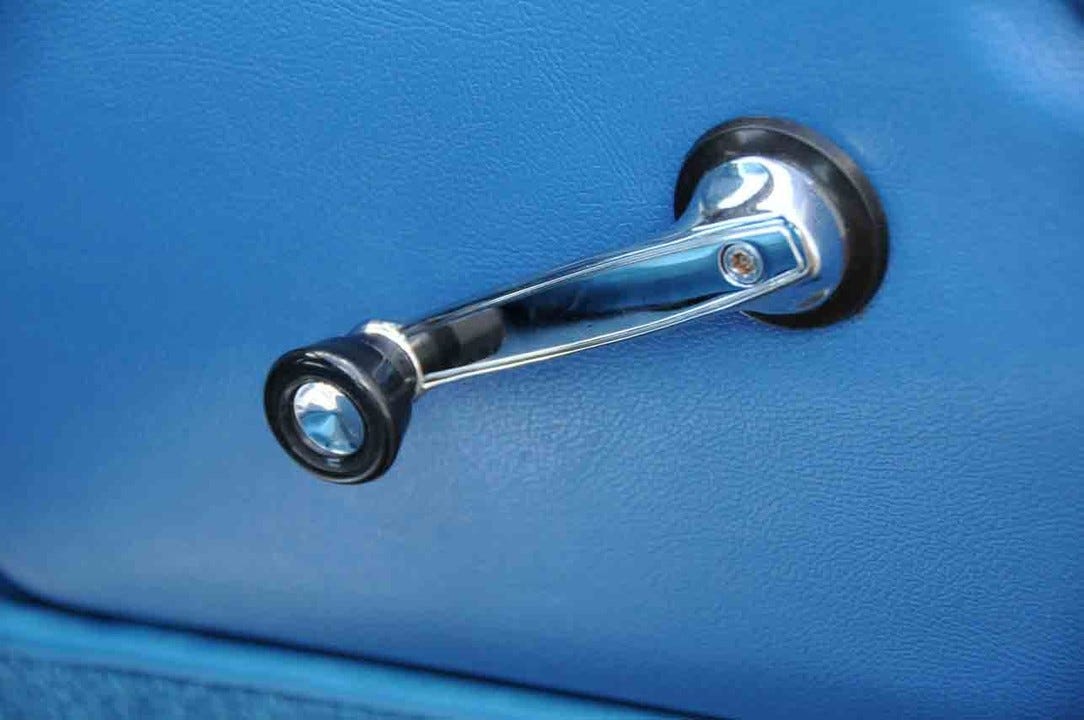
And that was it. There was a definite problem, and an elegant solution.
So this went on, throughout the history of cars, for a good 6 or 8 decades. It didn’t change much, because, well, it worked. and seriously well, a thing of beauty in it’s function and design. The handle felt good in your hand, and you knew exactly what to expect when you “rolled” it, in either direction. It became ubiquitous, an every day thing you used, didn’t think about, and it functioned properly when you needed it to.
So along come the 60’s, and the rise of the “luxury” cars. Here’s a fictional account of the marketing meeting that might have taken place.
The Innovation - 1960 something
Frank (Marketing director): ”So guys, we gotta stand out, Lincoln is making ground on us, and Cadillac has some crazy innovations coming. We gotta keep pace, what have we got to set us apart? Anyone?”
Sal (Marketing Rep): “OK I am just spitballing here, it’s not all gonna be gold, but what if we remove those functional handles that make the windows roll up and down, and replace them with an electric motor, you know, touch a button, the window goes down, touch it again, it goes up?”
John (Marketing Rep): “hey you know we have these rocker buttons, what if you push it one way to go down, and pull it back to go up?”
Frank: “I like it. we remove those big, ugly mechanical handles, and there’s more room for the pleated napa leather. Luxury! Bill, can we do that?”
Bill (Engineering Manager): “ Well, yeah, but you are taking something that has worked, and adding cost, electrical parts,, switches etc, to do a pretty simple task. You think that will go over”?
Betty (Marketing researcher): “Well, our surveys indicate, that our customers want to feel like the car is doing their bidding. Yes, it’s a simple task, but one that sends the message, “You are in control”.
Frank: “Alight then, let’s get this thing going, and ad campaign to go with it. I am picturing a woman in the passenger seat, gently reaching over, to touch the button”.
John: Hey one more thought on the whole “control” idea. What if we put a switch for every window at the drivers side? You know MASTER control"?”
Bill: “Now wait a minute, that requires a lot of extra wiring, so each window has to have a switch, and a second switch at the drivers door? You’ve just tripled the complexity, I don’t even know if assembly can handle it. It might require a new factory division, just to assemble the doors ahead of install.”
Frank: “Bill, I feel like you are not a team player here, can you get with the program on this?”
Meeting adjourns. Behold. We have an electric wiring harness, Four electric motors, eight rocker switches if. you count the lock out feature. Just to operate the windows.
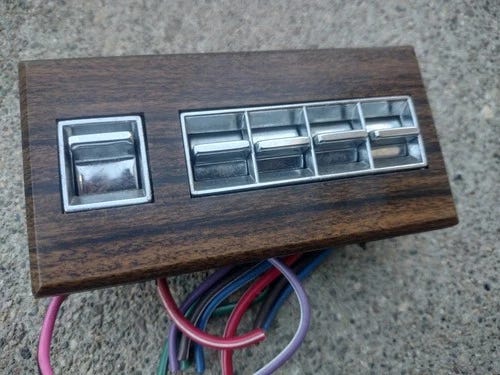
But we are not done yet.
The Circuit Board
Sometime in the late 2000’s, as technology grew to include circuit boards and further computer technology, there grew a need. Not from the customers, but from the people who had all this computing power at their finger tips. And they were bored. Circuit bored. So behold, the next level Marketing meeting.
Rob (Interior Design Senior Marketing Director): “So we have all this ability to control things down to the smallest task, what are we gonna come up with to set us apart?”
Liam (Senior UX Innovator): “OK, I am just spit balling here, it’s not all gonna be gold. You know how you have to push that rocker button to put the window down? What if we make it so that, if you flick it, you know just for like one second, we put the window down like ALL the way for you? And if you want it half way, you hold it like normal?”
Skyler (UX Intern): “Brilliant! Like that would so cool!”
Jonas (Electrical Engineer): “well, we can do that, but wouldn’t it be confusing, you know, a short hold means all the way, and a long hold means part way? Am I missing something here? How do you get the window back up again?”
Rob: “Well, can’t we just reverse the logic, you know hold it for just a second, Boom, all the way, hold it for longer half way. Jonas, I need you to be a team player on this one, this could really set us apart as a technology innovator”.
Lexa (User researcher): “ we could do a focus group with some mocked up buttons, and get a reaction.”
Brian (Technical writer): “we can help out with comm, we can add 2 pages to the 352 page owners manual, in the user interface Section about interior controls, Call it ‘how to operate the windows’. We can add graphics and everything”.
Tiffany (Sr Dealer Relationship Manager): “Oh the dealers will love this! You know anytime we can make the sales people look smart, and teach the customer something, it helps the “expert” view of the dealer, and the customers are like trained monkey’s they love doing something that looks like a skill.”.
Rob: “OK! I think we have a winner here. Let’s get on this people, we need software, engineering changes, factory upgrades, training, documentation, fail safes in case the programming goes haywire and the windows start rolling themselves up and down. Get the Recall group to have a placeholder bulletin, a press release denying any knowledge on our part, have the lawyers set aside litigation money for the lawsuits.”
Rob: “This is going to be big!”
Meeting adjourned.
(And, don’t get me started on locks, fobs and keyless entry).
Writers note: thanks to Jenn Collins for the inspiration, from her post The enshittification of Etsy.
This post, its about the over reach of technology for it’s own sake, or worse, for the sake of money. I am not a Luddite, really. I like technology, when it makes my life easy, and makes sense. I like buttons, but not too many. If they are mechanical even better.
I'm with you on this. I think my 2012 Subaru is one of the last mainly analog cars, and I hope to make it last for many more years (or at least until car manufacturers realize there's a market for cars that aren't so electrically/electronically enshitified).
Great read. I love this.
When I was a kid, my mom drove a massive, teal-green Cadillac. If you’ve ever seen License to Drive (Corey Haim, Corey Feldman, peak cinema. Be still my 1980s heart), it was basically that exact car. It was long, wide, loud, and it turned heads.
It also had electric windows, which at the time felt like living in the future.
But those windows worked only when they felt emotionally ready. I vividly remember winter drives where my mom would crack the window to ash her cigarette, only for the window to decide, actually, no, and freeze itself halfway down. So there we’d be: one adult swearing creatively, one child slowly turning into a human popsicle, both of us mad as can be at the rebellious pane of glass that had chosen violence that day.
That experience gave me a lifelong distrust of unnecessary electric features. If a thing does not need to be powered by wires, I would prefer it wasn’t.
That said, that Cadillac did have one truly perfect feature: a real, honest-to-God built-in trash can on the passenger side. A proper little wastebasket. I grew up assuming every car had one. I was wrong, and that disappointment has never left me.